Spring Clean Your Home Office: A 30-Minute Checklist
A practical 30-minute seasonal reset for your home office: clear the desk, empty a drawer, archive paper,...

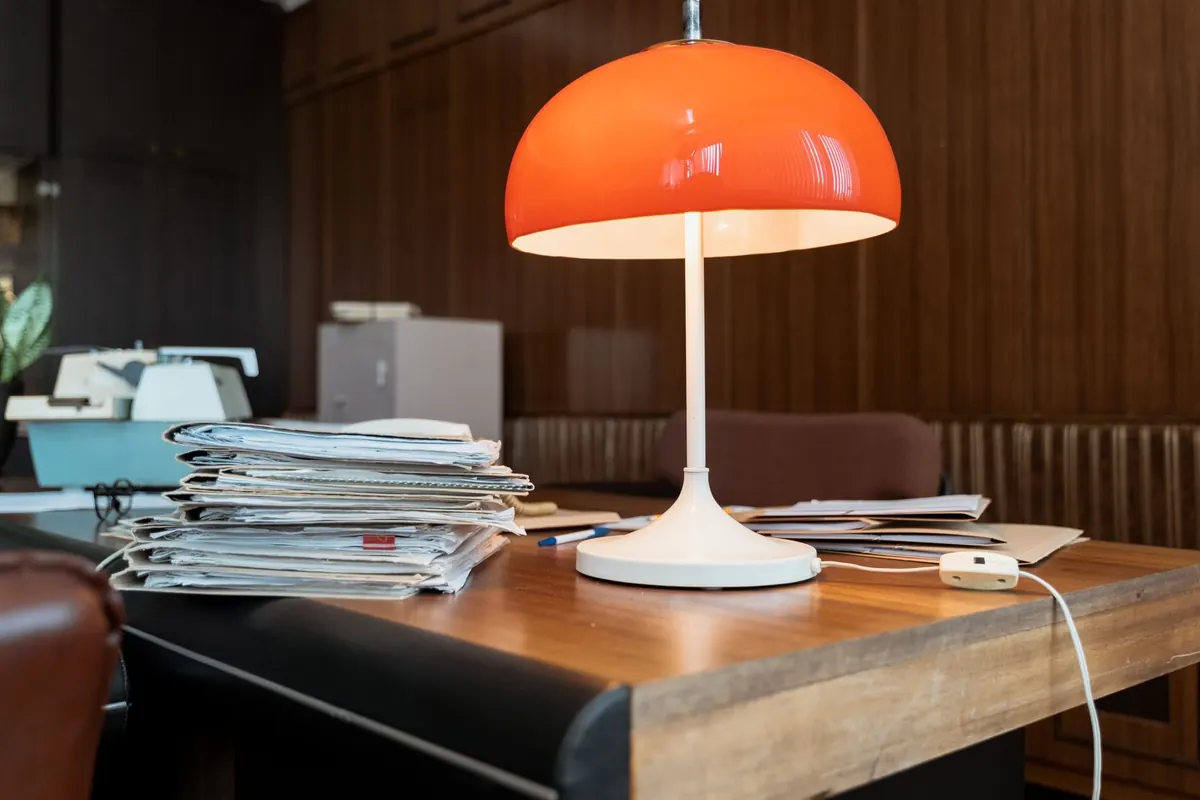
A spare bedroom, a corner of the living room, the end of a hallway — most home offices start life in the space nobody else wanted. That is fine. What causes trouble is treating a compact room like a full-sized study. Small rooms rarely fail because they are small; they fail because of a handful of decorating decisions that quietly eat the floor, block the light and crowd the eye.
The good news is that most fixes are cheap, quick, and rarely involve a builder. Here are the mistakes worth checking for, and what to do instead.
The most common mistake is buying for the job instead of the room: a wide desk because it was on offer, an executive chair with a thick back, a bookcase that just about fits a wall and then swallows it whole. Each piece seems reasonable on its own. Together they leave you squeezing sideways to reach the chair.
Stand in the doorway and look at how much floor you can actually see. If the answer is “not much”, the furniture is too big. A desk around 120cm wide and 50cm deep will hold a laptop, a second screen and a notebook comfortably. Sixty centimetres of depth sounds generous until you realise your chair has nowhere to sit.
Look for pieces that keep the floor visible:
Leave at least 80cm of clear floor between the desk and whatever sits behind it. If you cannot, the desk is the thing to change, not the walkway.
Dark corners read as dead space. One shadowy corner makes a room feel like a corridor with furniture in it; two make it feel cramped even when the measurements say otherwise.
The fix is usually light rather than furniture. A slim floor lamp angled up towards the ceiling lifts a corner without taking floor you need. So does a small mirror, positioned so it reflects a window rather than bouncing light back at the wall behind it. If a corner has to hold something — a printer, a bin, a stack of files — put it on a low, pale unit so the mass sits low and the top half of the corner stays bright.
Your main light matters too. A single ceiling fitting casts shadows exactly where you work. Add a task lamp beside the screen and a softer light for the rest of the room, and the space will feel wider after dark as well as in daylight.
Clutter is the quietest way to shrink a room. Every loose cable, sticky note, unopened envelope and mismatched pen pot adds an edge for the eye to process, and a small room runs out of processing room fast.
The desk is where to start. Aim to keep roughly two-thirds of the surface clear at the end of the working day — not because tidy looks better in photographs, but because empty surface reads as space. If everything on the desk has to stay, group it: one tray for papers, one pot for pens, one spot for the charger.
Cables deserve their own attention. A clip-on tray under the desk, a couple of adhesive clips down the back edge, and a single cable tidy where the wires meet the floor will remove more visual noise than repainting the whole room.
Open shelving is the other culprit. It looks light and airy in a large room, but in a compact one it turns every object into part of the decoration. Either fit doors, or use matching boxes and folders so your eye reads a calm row of rectangles rather than dozens of separate items.
Deep colours in a small office can look wonderful — cosy, considered, grown-up. The trouble starts when every surface joins in: dark walls, dark floor, dark desk, dark chair, dark curtains. With no contrast, there is nothing to tell your eye where the room ends and where the gap between objects begins.
Keep the bulk of the room light or mid-tone and let one element carry the drama. A single dark wall behind the desk, a deep-toned chair, or a rich rug on a pale floor will all work. Keep the ceiling lighter than the walls if you can, and continue the same floor colour from the hallway into the office — an unbroken surface makes the whole run feel longer than it is. Busy, large-scale patterns have the same effect as clutter, so keep them for cushions and small accessories.
A small rug floating in the middle of a small room divides the floor into even smaller pieces. Either choose a rug big enough for the desk and chair legs to sit on it, or skip the rug entirely and enjoy the unbroken surface.
Windows are often blocked by accident: a blind mounted inside the recess so it covers the top of the glass, heavy curtains drawn across the edges, a tall shelf planted in front of the brightest spot. Mount curtains or a roman blind well above the recess and extend them past the frame on both sides. The window will read as bigger, and more daylight will land on the desk.
Where you point a mirror matters here too. One that reflects the window doubles the light; one that reflects your monitor and a pile of paperwork doubles the clutter.
When storage is bought last, it arrives as a mismatched collection of boxes, a looming wardrobe that blocks the door swing, or shelves packed so tightly that nothing can be found. Build it in from the start instead: go upwards with a high shelf above the desk, choose closed cupboards over open ones, and keep boxes and folders in one colour family so they recede rather than compete.
One tall, shallow unit will nearly always beat two squat ones. It uses vertical space you are not walking through, and it leaves the floor around it clear.
You do not need to redecorate. Work through this in an afternoon:
Make those changes and the room will not suddenly gain a metre. It will simply stop working against you — and that is usually enough for a small space to feel calm, bright and perfectly big enough for the work you do in it.
Photo: MART PRODUCTION / Pexels
A practical 30-minute seasonal reset for your home office: clear the desk, empty a drawer, archive paper,...
A practical £300 plan for a home office, covering where to spend first, how to choose a second-hand chair,...
A rented flat doesn't have to mean a dull video background. Here's how to shape the wall behind you, light...