Spring Clean Your Home Office: A 30-Minute Checklist
A practical 30-minute seasonal reset for your home office: clear the desk, empty a drawer, archive paper,...

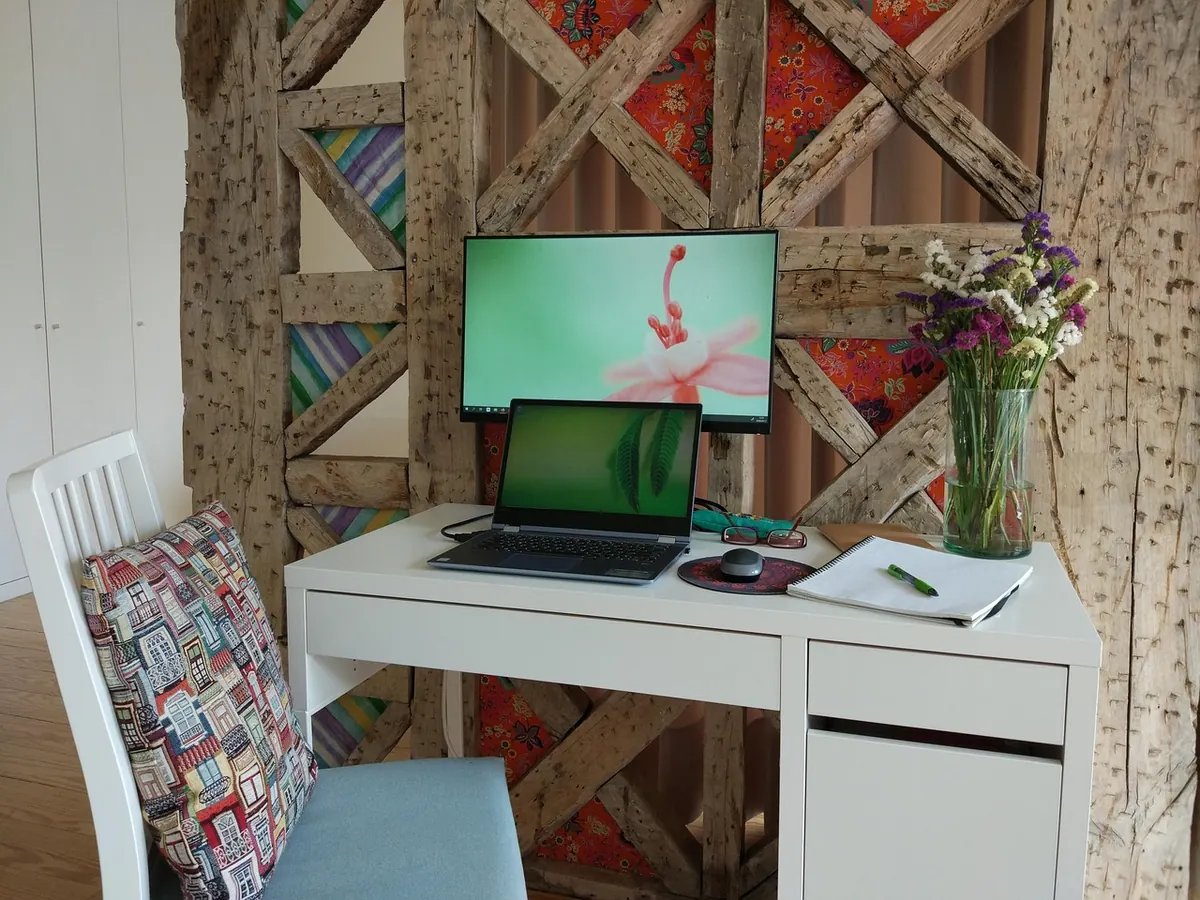
A spare room can make a genuinely good home office. What usually spoils it is not the width of the room but the depth of the desk. You measure the wall, buy something 60cm deep because that is what everyone buys, and discover on the first morning that you cannot push your chair out far enough to stand up. Or you go the other way, buy a slimline 40cm desk, and spend the day hunched over a screen that sits far too close.
Getting this right takes about twenty minutes with a tape measure. Here is how to work out the depth your room can actually take, and how to make a compact desk feel comfortable enough to sit at all day.
Start with the whole room, not the patch of wall you have mentally set aside for a desk. Write down the length and width, then walk the perimeter and note anything that interferes:
Then mark the desk footprint on the floor with masking tape, along with the chair zone behind it. Standing inside the taped outline tells you more than any product listing.
Desk depth. Most desks sold in the UK are 60cm deep, which is a sensible default for a monitor plus keyboard. Compact and slimline desks usually run 45–50cm. Anything under 45cm is really a console table and only works for a laptop and a notepad.
Chair clearance. This is the number people forget. From the front edge of the desk to the nearest obstacle behind you — wall, bed, wardrobe — allow at least 75cm. That lets you roll back and stand up without clambering. If you want to walk behind the chair while someone is sitting at the desk, allow 90–100cm.
Say your spare room is 2.4m by 3m, with the door on a short wall. Put the desk along the longer wall and you have 3m of run, minus the door swing. Place the same desk on the opposite long wall and you have 2.4m of depth in the room: take away 60cm for the desk and roughly 60cm for the chair and the person in it, and you are left with about a metre behind. That works. The same 60cm desk on the short wall would leave more room to spare, but you would lose the option of a second chair or a shelf unit.
Your eyes want to be roughly an arm's length from the screen — around 50–70cm for a typical 24-inch monitor, a little more for anything larger. Sit up straight and the top third of the screen should be roughly level with your eyes.
This is where shallow desks bite. A 50cm desk with the monitor pushed back puts the screen about 50cm from your eyes, at the near end of comfortable, and leaves very little room for a keyboard and your hands. Two fixes work well:
It helps to know what lands on the surface. A keyboard takes around 15cm of depth, a monitor base about 20cm, and your forearms want another 10–15cm in front of the keyboard. On a 60cm desk that leaves roughly 25cm of clear space for a notepad, a mug and a phone. On a 50cm desk it leaves very little.
Shelves above the desk cost you no floor space. Allow 45–60cm of clear height between the desktop and the first shelf so you are not ducking under it, and keep the heaviest items at the ends rather than directly over your keyboard.
A chair with a five-star base and a deep recline needs more pull-back room than a compact task chair or a fixed stool. In a tight room, a smaller chair can be the difference between a workable desk and an awkward one.
You need roughly 60cm of knee width and 65cm of height beneath the worktop. A deep drawer unit or a chunky pedestal takes that away, so favour slim legs or an open frame and store paperwork elsewhere.
If those five things work on the floor, they will work with furniture in place. One last note on comfort: if you are already managing back, neck or wrist pain, speak to a physiotherapist or your employer's occupational health team rather than relying on general sizing advice — desk dimensions are a good starting point, not a diagnosis.
For most small UK spare rooms, a 50–60cm desk with a genuine 75cm of chair clearance behind it will feel far better than a deep desk you have to climb out of. Measure twice, tape it out once, and the room will do the job you bought it for.
Photo: judyback / Pixabay
A practical 30-minute seasonal reset for your home office: clear the desk, empty a drawer, archive paper,...
A practical £300 plan for a home office, covering where to spend first, how to choose a second-hand chair,...
Oversized furniture, dark corners and visual clutter all shrink a small home office. Here are the common...